THE QUANTUM DEADLINE: Telcos Face a Make-or-Break Moment
Extended version of an Editorial Opinion published in The Fast Mode . The article is also available on Medium.
Our lives increasingly take place in a virtual world, humans connect on social media, shop online and our health records are uploaded to an enormous cyber cloud. All this has tremendous upsides and —after all—our data is protected via encryption. Still, data breaches are becoming more and more common—encrypted data is stolen and stored by state and non-state players with one goal: decrypt this data later, an approach referred to as harvest now, decrypt later (HNDL) .
What are the entities involved in HNDL speculating on? Rapid technological progress. Large language models, LLMs, for instance have emerged at a pace that even the most bullish experts didn’t anticipate. Meanwhile, quantum computing (QC) breakthroughs are stacking up faster than expected—with test results showing performance gains far beyond the most optimistic projections.
In my view, the ascent of QC will follow a similar path to generative AI: it will appear suddenly and develop at breakneck speed. Operational QCs will allow quantum decryption, which will break current encryption standards like a hammer cracks a walnut. All of a sudden, it does make sense to steal encrypted data, because it won’t be encrypted for long, QC is closer than we think. That’s why we need to confront its consequences right now!
The Illusion of Time: Why 2030 Is Too Late
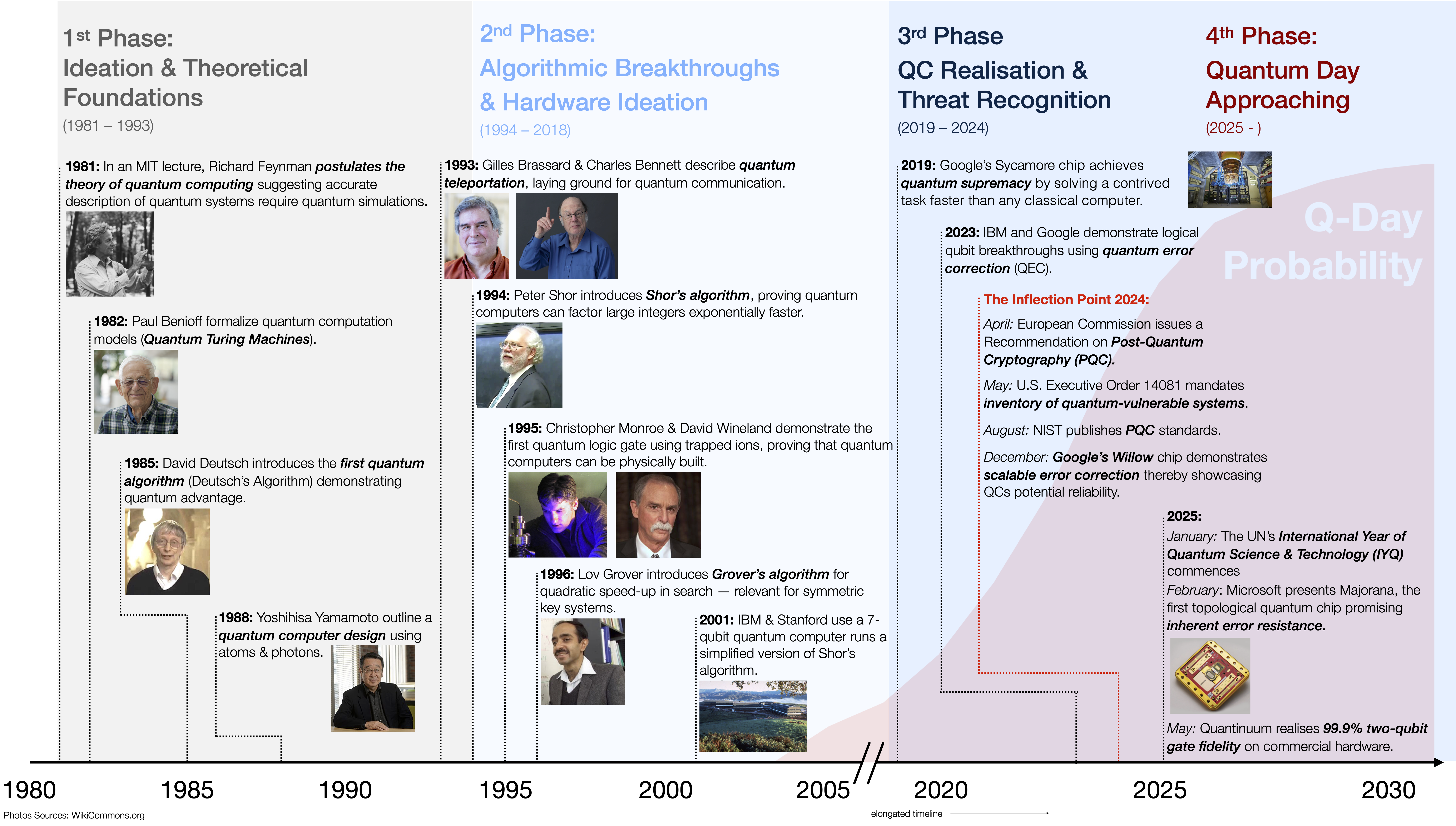
Until recently, 2030 was considered the earliest possible date for cryptographically relevant quantum computers (CRQC). However, that timeline is rapidly collapsing as in the past year alone :
- Google’s Willow reduced a 10-septillion-year problem to a 5-minute calculation.
- Microsoft discovered a new quantum phase of matter, a breakthrough for error correction.
- D-Wave and Quantinuum solved previously intractable problems.
Perhaps most significantly, we’re seeing the first signs of a quantum–AI feedback loop: artificial intelligence is accelerating quantum computer design and operation , and quantum machines will soon return the favour. These developments strongly suggest that cryptographically relevant QCs will be operational years earlier than even the most optimistic forecasts predicted. In short, the so-called Q-Day—the day when current encryption will be rendered useless by operational QCs and their deciphering abilities —is approaching rapidly. The graphic below gives a short timeline of quantum computing, from Feynman’s ideation to the near future. The probability of Q-Day hitting this decade is, in my opinion, close to 100% and this will have consequences for every one of us as we’ll explore hereafter.
The End of Privacy: What Quantum Decryption means for all of us
What policymakers and telecom leaders must understand: the “harvest now, decrypt later” threat is no longer theoretical. State intelligence services and corporate espionage actors have already harvested vast troves of encrypted data—just waiting for them to be unlocked by the Quantum Dietrich—a truly universal digital lockpick. A 2024 briefing from the European Parliamentary Research Service and a 2022 white paper from the World Economic Forum confirm that state and corporate actors are hoarding sensitive communications today, betting on future decryption. Hence, HNDL attacks are selectively targeting data with long-term value such as health and financial records, government data, corporate IP and other Personal Identifiable Information (PII), the graphic below shows a breakdown.
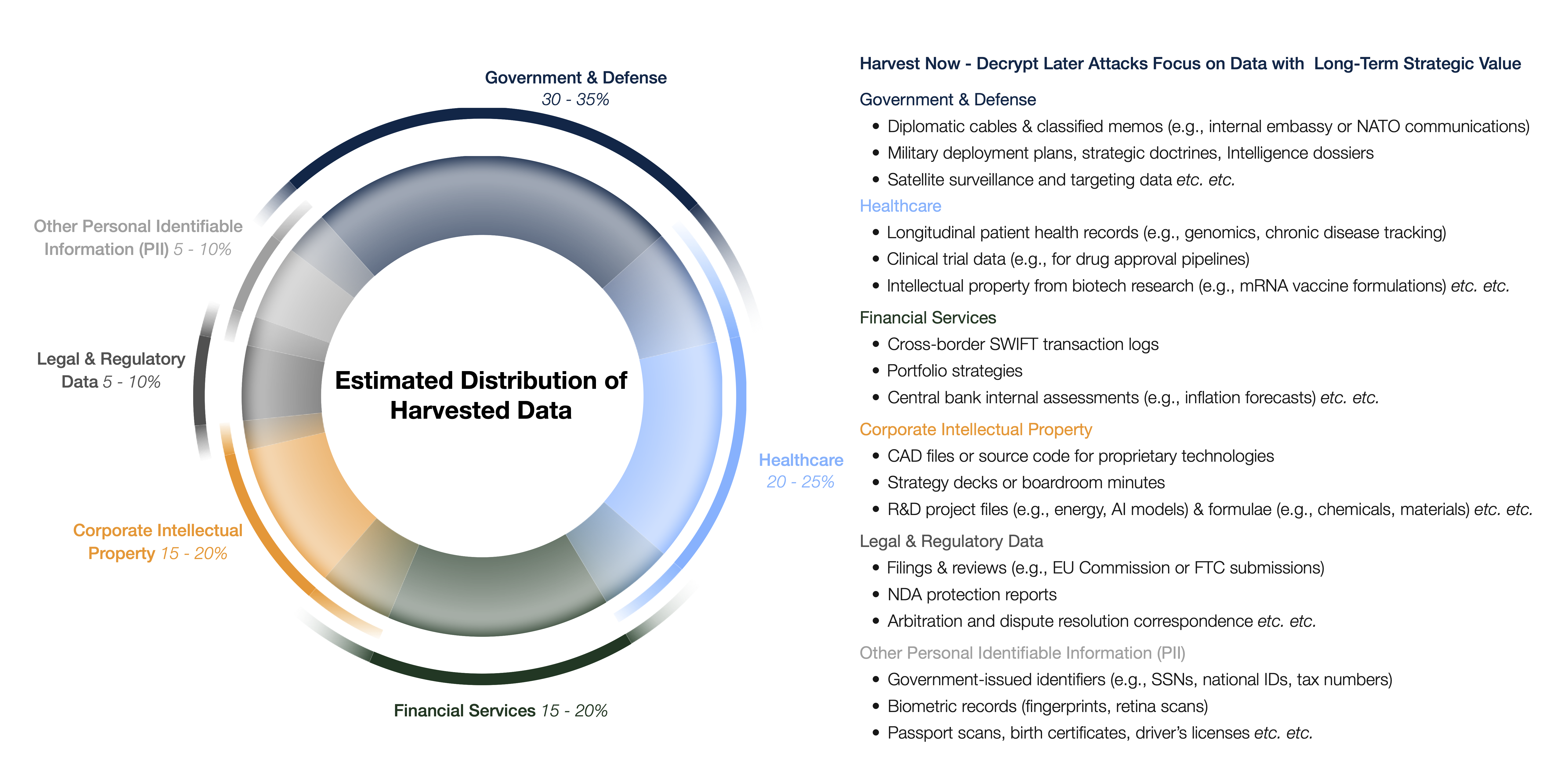
Once CRQCs arrive, decades of encrypted secrets—health records, financial transactions, state communications—WILL be exposed retroactively. The inflection point of quantum decryption will reverberate through the global economy, national security and the financial system—read an assessment of these effects in this article.
Public Duty: Why the Telecom Industry Must Lead
The telecommunications industry is key to safeguarding our national interests, economic wellbeing and privacy; they are the pillar of the digital infrastructure as they own fiber networks, edge facilities and data centres. This infrastructure is key to QC operation, however, it is also the Achilles heel as it is the entrance point of malign entities preying on data; industry leaders have the duty to think ahead and implement safeguards for nation states and their inhabitants. One could counter this statement with the fact that it indeed the state that should implement these safeguards, yet, this time it is different as we’ll explore hereafter.
The Governance Lag: Policy is Struggling to Keep Up
Technological innovation has long outpaced democratic decision-making. Not due to unwillingness or inertia, but because democratic processes require consensus-building, consultation, and regulation drafting—all inherently slow. By the time legislation catches up, technology has already evolved—and this trend will not reverse. Policy makers have to prioritise smart and adaptive policies that automatically adapt to tech developments – I am well aware that this is easier said than done, yet successful examples of such political innovation exist! The United States via NIST’s Post Quantum Encryption Standards and the European Union via its European Quantum Act, have taken measures, but there will be a lag between action and implementation.
In the meantime, the telecommunications industry, masters of the digital infrastructure, have to step in and take responsibility—the means to upgrade telecommunications are available the means to upgrade telecommunications are available. In the medium term, the industry will benefit from this.
Enormous Opportunity: Another Frontier Era Within Reach
The risk story is clear—but the opportunity story is just as compelling. Quantum computing doesn’t just threaten existing systems; it offers telecoms a pathway to growth, differentiation, and relevance in the next technological era. Telcos stand to benefit in two major ways: first, by commercialising Quantum-Computing-as-a-Service (QCaaS) Quantum-Computing-as-a-Service (QCaaS) for industries such as banking, pharmaceuticals, logistics, and cloud computing; second, by using quantum algorithms internally to optimise routing, reduce energy use, and enhance fault prediction. Industries like transport, energy, and hyperscale cloud platforms are already exploring quantum-enhanced efficiencies —and they will pay a premium to access these capabilities through trusted telecom partners.
According to McKinsey, quantum-encrypted communication (QEC), i.e. a safeguard against quantum decryption, will likely be the first QC-related commercial product with an estimated market size of US$13 billion. Figure 3 illustrates the scenarios for the market size of the safeguard by 2035 giving the actual 2023 market size as benchmark. The compound annual growth rate (CAGR) of 23 to 25 % clearly illustrates a key message:
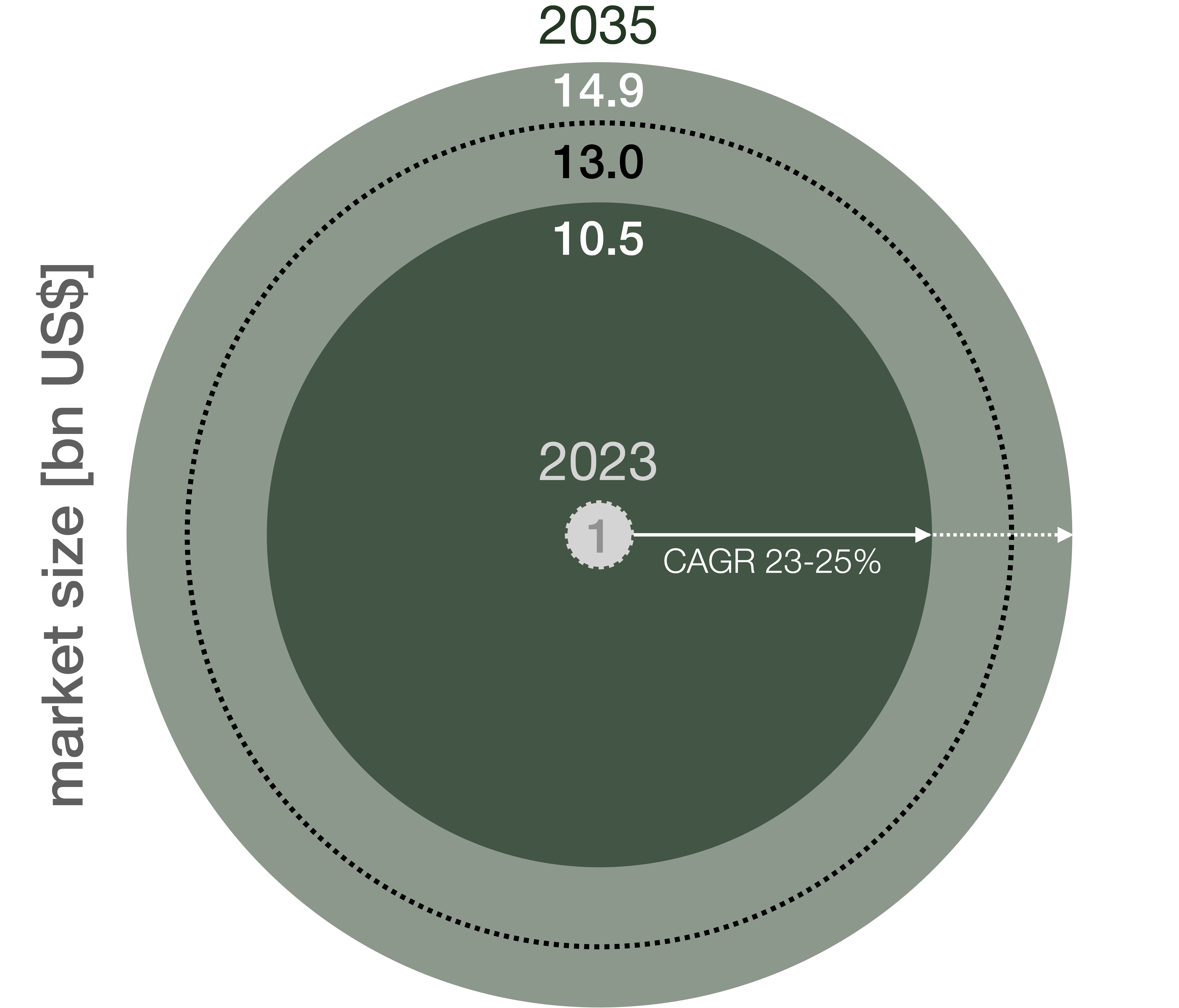
Quantum computing isn’t just a risk; it brings enormous economic, environmental and societal opportunities—and the telecom sector is uniquely equipped to reap these benefits.
The Time is Now: The Roadmap to Quantum Readiness
There is no silver bullet—but there is a clear path forward. Telecoms can begin by laying the groundwork: auditing quantum risk exposure, launching post-quantum cryptography in sensitive sectors, and identifying fiber corridors for quantum key distribution. The second phase could involve piloting of QKD in selected sectors, building sandbox environments for quantum-safe 5G/ 6G, and training internal teams. The final phase is scale and monetisation—offering QCaaS to enterprise clients, integrating quantum optimisation into network operations, and establishing regional quantum backbone status. Each step compounds strategic advantage—and shrinks the window of vulnerability.
The Bottom Line: Quantum Decryption Will Emerge—But It Won’t Announce Itself
Quantum decryption won’t arrive with ceremony. It will arrive quietly—and with seismic consequences. It will shake the foundations of global security, enterprise trust, and data governance. The telcos that act now will become national assets. Perhaps even digital first responders in a new kind of technological emergency. Those that delay? They risk irrelevance—or worse. Telcos have already mastered electricity and light harnessing the economic benefits. I believe they can master & monetise the quantum revolution as well—if they act now.
This article is part of an ongoing discussion on emerging quantum risks. A shorter, reader-focused version is available on Medium.
Interested in how advanced digital technologies will shape the future? Please check out my other articles on artificial intelligence, quantum computing, brain-computer interfaces and more:
Quantum Computing
- THE QUANTUM COMPUTING REVOLUTION: Unlocking Solutions to Humanity’s Toughest Problems (Part 1)
- THE QUANTUM COMPUTING REVOLUTION: From Technological Opportunity to Geopolitical Power Shift (Part 2)
Artificial Intelligence
- THE ASCENT OF AI: Is it Already Shaping Every Breakthrough and Even Taking Over Creativity?
- REALITY ISN’T WHAT IT USED TO BE: How AI Could Converge Our Understanding of Reality, Perception & Consciousness